by Chris Pfaff
CEO, Knox County Indiana Economic Development
For decades, a substantial part of economic development — including rural efforts — revolved around a single, enticing idea: land the big employer. Chase and recruit the smokestack plant. Assemble the local officials, cut the ribbon, and wait for the jobs to follow.
In the past, this strategy produced some genuine wins, particularly in old-style manufacturing operations. But, as Indiana painfully discovered in the late 20th and early 21st century, this focus underscored how fragile a local economy becomes when its fortunes largely ride on margin-focused corporate decisios made hundreds of miles away.
What’s the best approach for regional economic growth as we approach the third decade in the 21st century? Hard data tells us a surprisingly different story about where real lasting and durable jobs can actually come from.
Who creates new jobs?
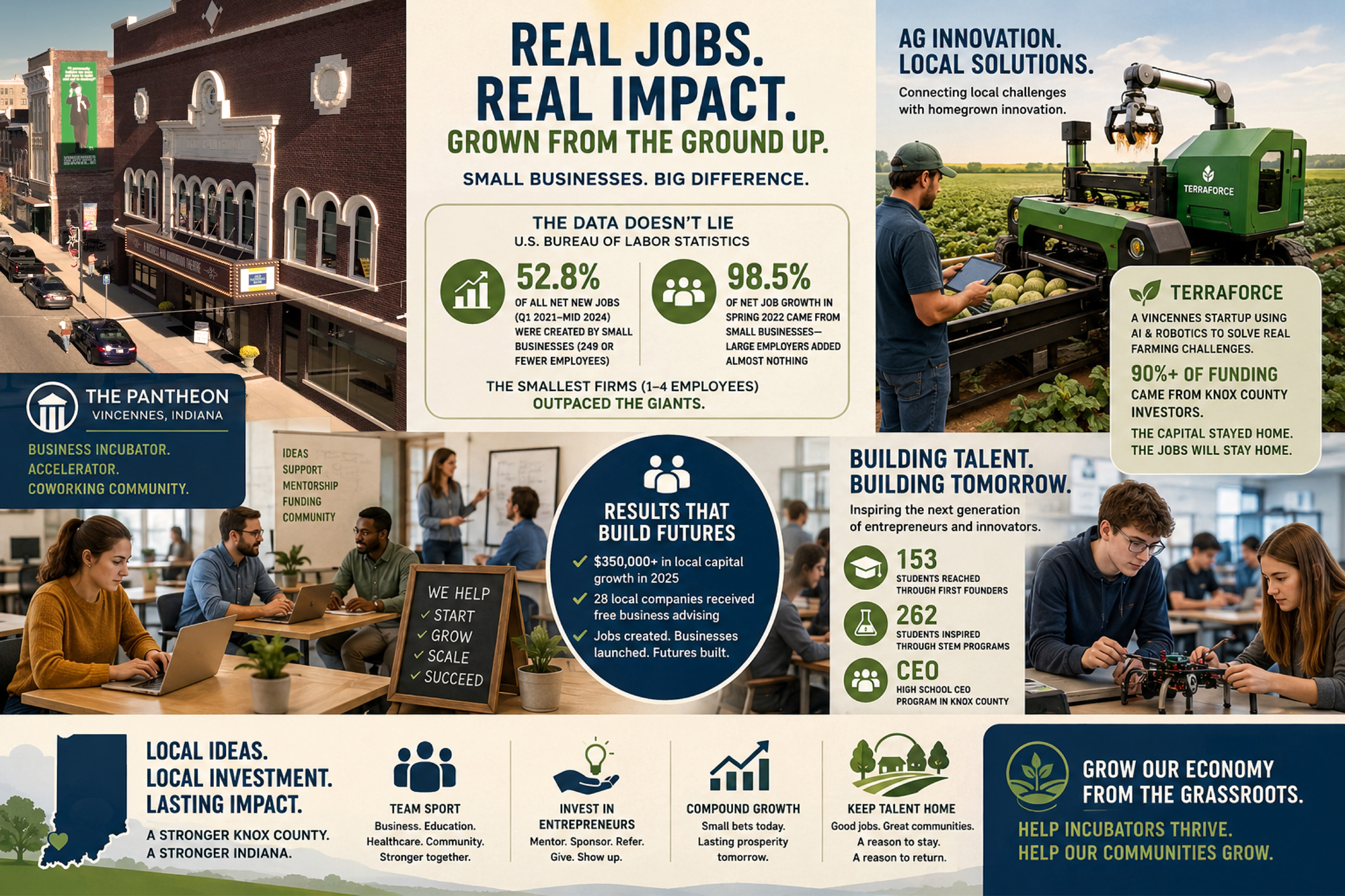
A review of information from the U.S. Bureau of Labor Statistics shows some myth-busting facts: smaller firms — those with 249 or fewer employees — generated an amazing 52.8% of all net new jobs in the United States between the first quarter of 2021 and the middle of 2024.
But the imbalance grows even more striking during periods of economic challenges. In the spring of 2022, small businesses accounted for roughly 98.5% of the nation’s net job growth, while the largest employers added almost nothing. The BLS even found that the very smallest companies, those with one to four workers, outpaced the giants.
Of course, the presence of a large-scale employer in a community generally brings a variety of important benefits. But real job creation, it turns out, is overwhelmingly a small-business phenomenon.
That finding ought to reshape how counties and regions think about their futures. If most new jobs are born inside small and young companies, then at least in some cases the highest-return economic-development investment actually falls here: the unglamorous, patient work of helping local people start and grow their own businesses—and giving them somewhere to do it.
Want an example? In Knox County Indiana, that “somewhere” has a name: The Pantheon.
Here’s how this works, and how it can work in your county or region.
Mission: grassroots economic momentum
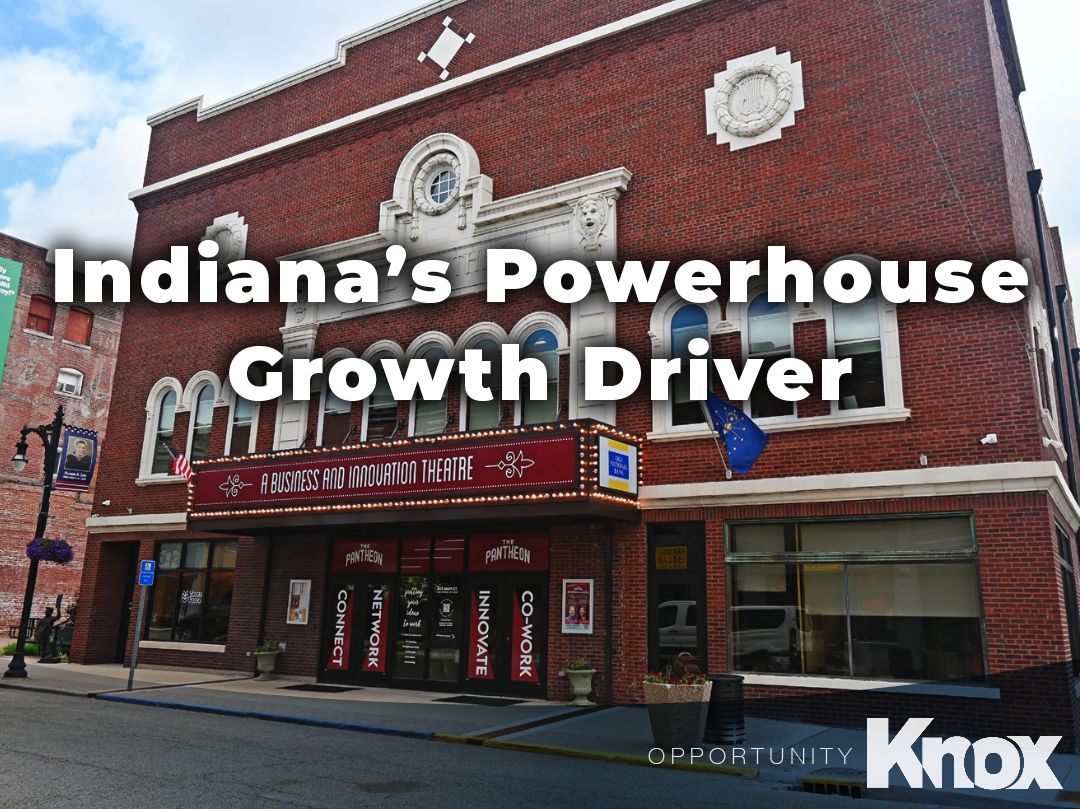
Housed in a thoughtfully restored and repurposed 1920s theatre on Main Street in Vincennes, The Pantheon has carved out a new resourceful role as a nonprofit business incubator, accelerator and co-working center rolled into one. Its 15,000 square feet hold open desks, private offices, conference rooms and a working stage — but its real product is momentum.
Its mission is to spark innovation and fuel entrepreneurship by helping new and existing Knox County businesses grow. It delivers on that mission in several ways: free one-on-one advising from the Indiana Small Business Development Center, mentorship from entrepreneurs-in-residence, hands-on workshops, access to critical start-up funding, and a community of people who have all decided that ambitious things can happen right here.
The same model can apply in your region or county.
The results are not abstract. In 2025 alone, businesses connected to The Pantheon generated more than $350,000 in local capital growth, and 28 local companies received free business advising. A graphic designer who walked in as a one-woman shop secured grant funding and hired her first employees. A footwear brand and a marketing agency launched and scaled with help from the network around them.
Of course, none of these are mega-corporate headquarters. But all of them are precisely the kind of small, homegrown firms the national data identify as the country’s most reliable job creators.
What makes incubators like The Pantheon especially insightful is an incubator’s refusal to treat entrepreneurship as something separate from the region’s economic identity. Knox County is one of Indiana’s agricultural powerhouses, and The Pantheon has leaned into that strength through an ag-technology initiative that connects farmers facing real operational problems with innovators capable of solving them.
Entrepreneurs bring it home
Want proof of how local success can be achieved in a rural county? A clear example is TerraForce, a startup founded by a Vincennes engineer and farmer that built an AI-driven robotic harvester to confront the rising cost and scarcity of seasonal labor—a challenge every melon grower in the county understands. Tellingly, more than 90% of TerraForce’s funding came from Knox County investors. The capital stayed home. The intellectual property stayed home. The jobs will stay home.
This story is repeated in similar form across existing incubators in the state.
Further, when other critical economic influencers like Good Samaritan Hospital recruits highly-trained physicians and medical professionals, those recruits often are in a relationship with a highly motivated and talented person who is looking to start a new business or bring their established business to Knox County. The Pantheon figures highly in satisfying this need.
A critical point? Local economic development is a “team sport.” The county’s task is twofold: cultivate good ideas right here through business growth and use those ideas to attract and retain the talent and businesses that keep a rural community vital. Those two goals reinforce each other. An incubator that helps a 26-year-old launch a viable company is also giving that person—and the peers he or she hires—a reason to build a life in Vincennes rather than Indianapolis, Nashville or Chicago.
This is the part of the equation local leaders too often overlook. The hardest problem facing counties like Knox and other regions in Indiana is not a shortage of land or even capital; it is the slow leak of talent and population decline.
Changing the talent calculus
A fact that we don’t often like to think about is that bright young people leave for opportunity and rarely return, because the opportunity isn’t visible at home. The good news? An incubator changes the calculus. It makes entrepreneurship legible to a high-schooler through programs like First Founders, which has already reached 153 students, and the 262 local students taking in The Pantheon’s STEM education work last year. Factor in the successful high school CEO program in Knox County, and one can see the region’s culture starting to change.
Why is this important for economic development in the Hoosier state? These initiatives loudly signal to a professional considering a return that there is a place to land, a network to plug into and experienced people who will help. Over time, that reflects a major strategy in how a rural economy like Knox County’s (or any other rural region) can renew itself with durable, lasting businesses and jobs—not in a single ribbon-cutting, but in a steady accumulation of small bets that compound.
In Indiana, supporting business accelerators like The Pantheon is not charity. It represents infrastructure investment, every bit as consequential as a road or a high-speed broadband line. For businesses, that support can take many forms: sponsoring a program, mentoring a founder, renting space for an event, referring an aspiring entrepreneur through the door, or simply writing a check that helps keep the lights on. Each of those acts seeds the ground from which a local economy like Knox County’s will grow.
The big-employer dream will always be tempting, and there is nothing wrong with a thought-through strategic pursuit. But the rock-solid arithmetic of durable job creation is clear, and its value proposition points homeward. Transformational economics spring out of accelerators like The Pantheon, 16Tech, the Purdue Ag-celerator, Hub & Spoke, Launch Fishers, Amplify Bloomington and more across Indiana. Knox County is fortunate to have a place devoted to exactly that work.
A smart thing to do? Grow our economy from the grassroots and help these incubators thrive.
Read this story in Inside Indiana Business: Indiana’s powerhouse growth driver? It’s the one next door
A long-time economic development and defense industry professional, Chris Pfaff serves as CEO of Knox County Indiana Economic Development.