
By Chuck Johnson, Forbes Councils Member.
By 2033, U.S. manufacturing will require up to 3.8 million additional workers. Deloitte and The Manufacturing Institute estimate that roughly 1.9 million of these jobs risk going unfilled if business leaders cannot bridge the skills and applicant gaps. Compounding this challenge, domestic manufacturing construction spending has nearly tripled since mid-2020, driven by more than 300 planned clean technology and semiconductor and advanced electronics facilities expected by 2031.
For business leaders across manufacturing, logistics, healthcare, construction and technology, the immediate impulse is to ask: Where do we find more talent?
While this is an understandable question, I propose that it is the wrong one. The real challenge facing modern industry is not simply a shortage of workers; it is a shortage of specific, rapidly changing capabilities—technical, digital, mechanical and adaptive skills that shift as quickly as new equipment and automation are deployed. The World Economic Forum projects that 39% of workers’ core skills will change by 2030. Yet data from the National Skills Coalition reveals that while 52% of U.S. jobs require skill training beyond high school, only 43% of workers currently have access to it.
Employers cannot recruit their way out of a structural labor deficit by competing for the same limited pool of pre-trained candidates. That is why I recommend a fundamental mindset shift: Stop searching for talent and start building it.
Higher education and government leaders can adapt to support this change. For too long, institutions have viewed degree programs and employer training as separate entities. What we should be focusing on today are flexible, integrated workforce models that meet business needs in real time.
Four Actionable Strategies For Bridging The Gap
1. Don’t force corporate partners into existing academic boxes.
Businesses can engage with local higher education partners to create custom workforce development programs rather than off-the-shelf course catalogs. Instead of relying on long academic semesters, consider partnering with institutions to launch accelerated, specialized boot camps built directly around your company’s current operational goals, diagnostic needs and machine-specific skill gaps. I have seen many programs of these kinds, ranging from four-week hands-on intensives to 1,500-hour comprehensive technical programs. (Full Disclosure: My university is one of many that facilitate these kinds of boot camps.)
2. Adapt models for your company’s size.
While large enterprises can support centralized training hubs, I have seen small and medium-sized enterprises (SMEs) successfully adapt these strategies through flexible, fractional scheduling. SMEs don’t need to pull workers off the line for months. For example, by sending technicians for targeted training just one day a week, you could not only empower your employees to master advanced troubleshooting and diagnostic skills in a lab environment but also see them immediately begin to apply those skills on the manufacturing floor.
3. Encourage government policy to align with industrial agility.
While businesses don’t have direct control over government policies, business leaders can advocate for policymakers to shift from funding traditional, static education models to incentivizing agile, industry-led partnerships. This could look like streamlining workforce development grants, expanding tax credits for registered apprenticeships and subsidizing equipment upgrades for training facilities that partner directly with regional employers. I’ve observed that when public policy aligns funding with industry-recognized, stackable credentials, it can lower the barrier for companies of all sizes to reinvest in their existing workforce.
4. Train on real equipment and remove dead ends.
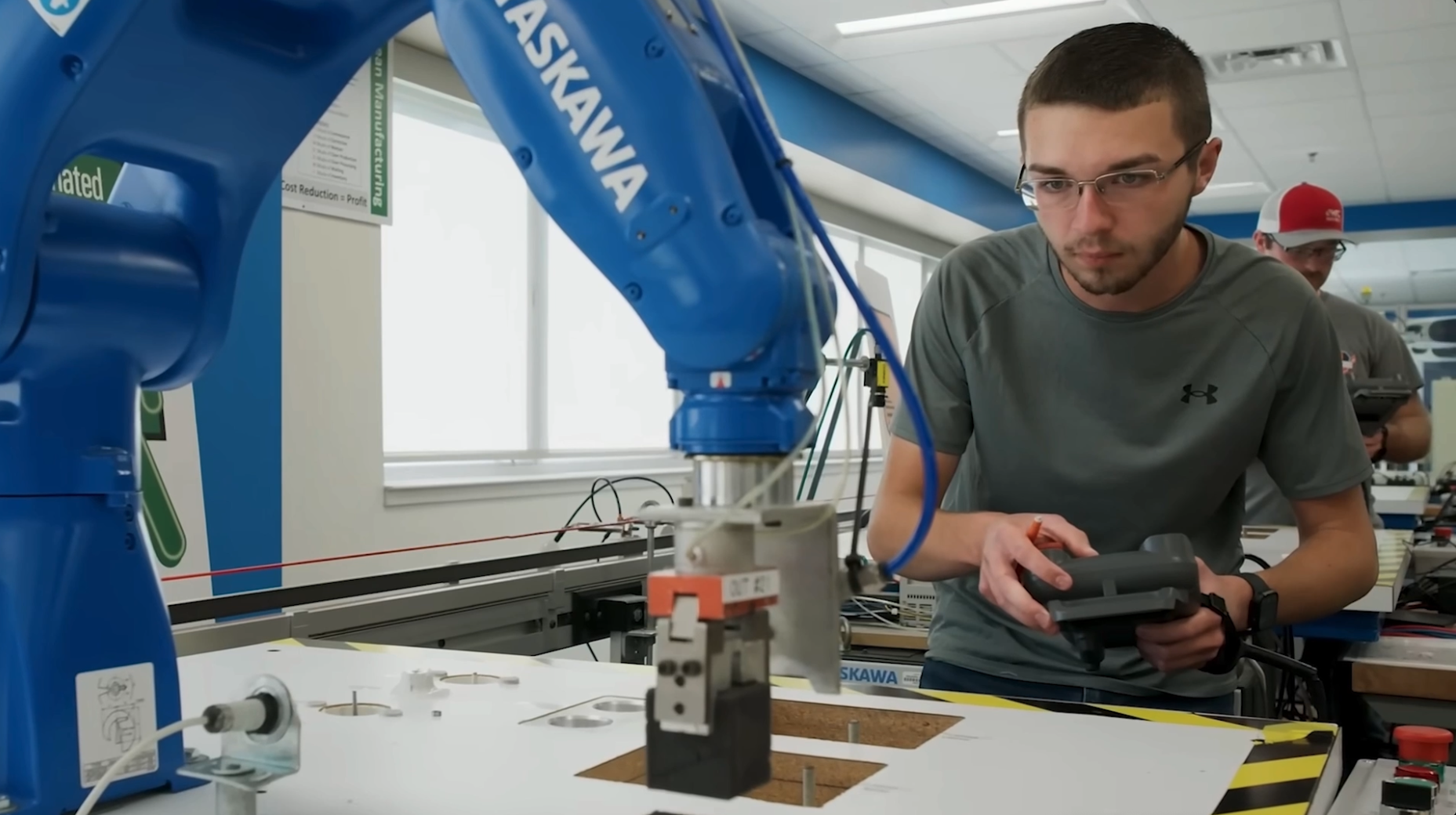
Training environments should mirror modern industrial operations, equipping learners with the exact pick-to-light fulfillment systems, collaborative robots (cobots), industrial robotics, programmable logic controllers (PLCs) and computer numerical control (CNC) machinery used on plant floors today. Furthermore, I encourage leaders to ensure their modern workforce models count every short-term certificate, on-the-job training hour and technical boot camp directly toward college credit and career advancement. Working adults should never have to choose between supporting their families and gaining technical credentials.
Ultimately, leaders across industries should treat workforce development as a core business strategy rather than a community service project. The cost of inaction can show up directly on the balance sheet through overtime pressure, production delays, quality issues and stalled growth. If we want to solve the labor crisis, we need higher education, industry, and government to step away from traditional silos; abandon one-size-fits-all programs; and build agile, problem-solving partnerships. The future of work is already here; the question is whether we are ready to build the workforce required to sustain it.
Dr. Chuck Johnson is President of Vincennes University.